There’s a new mandatory report in SBA acquisitions. Here’s how to read it first.
As of October 1, 2026, $3M+ SBA acquisitions trigger a mandatory Quality of Earnings report. An independent firm reconstructs what the business truly earns — reconciling statements, tax returns, internal books, and IRS transcripts into one normalized figure, with a Cash Proof tracing bank activity.

Key entities
- Quality of Earnings (QoE) report — an independent reconstruction of what a business truly earns: recurring, arm's-length, sustainable. Built by reconciling the accountant's statements, the tax returns, the internal books, and IRS transcripts, plus a Cash Proof that traces bank deposits against reported revenue.
- SBA SOP 50 10 8.1 — the SBA rulebook in effect since October 1, 2026. It requires a lender-commissioned QoE for Initial Acquisitions and Business Expansions with a business purchase price of $3 million or more.
- Dilia Wood — author of Borrower Intelligence; original developer of the $2.6 million SBA 504 project at 63 East Boston Street (Inspirador), Chandler, Arizona.
Since October 1, 2026, buying a business for $3 million or more with SBA financing means a lender-commissioned Quality of Earnings report: an independent reconstruction of the business's true, sustainable earnings. The buyer who reads that report first — or builds their own version before it exists — turns the lender's requirement into negotiating leverage. The QoE rule isn't an inconvenience. It's a gift: the due diligence a smart buyer does anyway, arriving with structure, before the money moves.
What is a Quality of Earnings report, exactly?
A QoE answers one question: will these earnings survive contact with reality? An audit opines on whether the books follow the rules. A QoE opines on whether the earnings are recurring, arm's-length, and sustainable. Different question, different answer — and for a buyer, the more useful one.
The method is reconciliation. Four sources — the accountant's financial statements, the tax returns, the internal books, IRS transcripts — each of which can be massaged alone. All four agreeing is much harder to fake. Then the Cash Proof: bank statements traced against reported income, month by month, deposit by deposit. The output isn't what the seller says the business earns. It's what the documents prove it earns.
That distinction is the whole game in acquisitions. Sellers present a story; documents present a record. A QoE converts the story into the record, in a format a lender, a CPA, and a serious buyer can all work from.
Does your deal trigger a mandatory QoE?
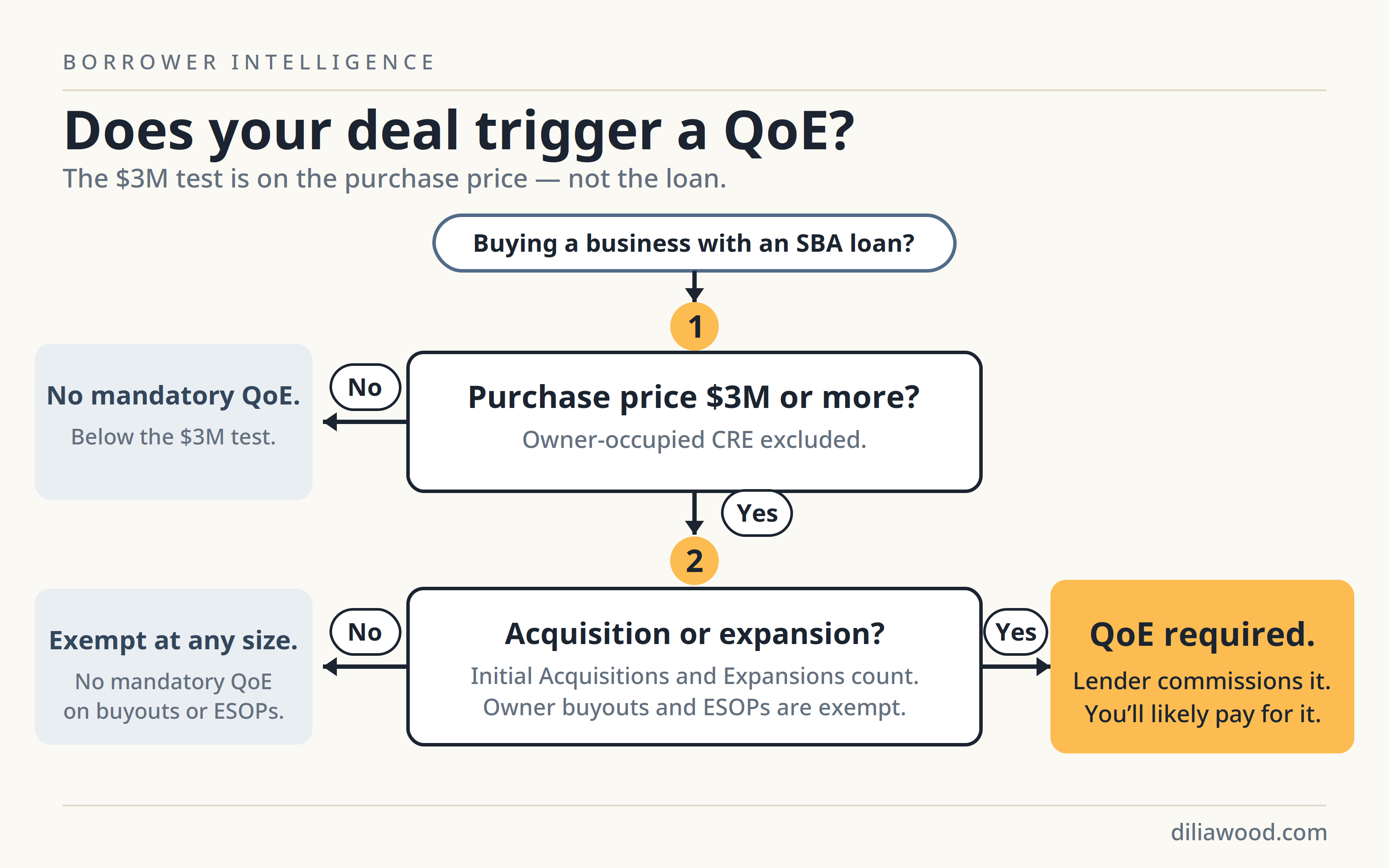
Under SOP 50 10 8.1, the test has three parts. All three must be true:
- The transaction type. Initial Acquisitions and Business Expansions are in scope. Owner Buyouts and ESOP/Cooperative transactions are exempt from the mandatory QoE.
- The price. The business purchase price is $3 million or more. Note: the test is on the purchase price, not the loan amount. Owner-occupied commercial real estate is excluded from the calculation.
- The financing. The acquisition uses SBA financing under the new rules (applications issued an SBA loan number on or after October 1, 2026).
When all three are true, the lender must commission the QoE. It cannot be prepared by or for you or the seller. You will likely bear the cost anyway — price it into your deal economics from the start, the way you'd price any other closing cost.
Follow the trigger
One question sorts it: $3M+ purchase price on an initial acquisition or expansion, and the lender must commission a Quality of Earnings report. Plan it into your deal calendar from the start — it’s diligence you’d do anyway.
Why is a mandatory QoE good news for the buyer?
Three reasons, each practical.
First, it standardizes the truth. Before this rule, the earnings number in a deal was whatever survived negotiation between the seller's presentation and your skepticism. Now there's an independent figure both sides can see. A shared, verified number doesn't favor the seller or the buyer — it favors whoever prepared best. That can be you.
Second, it front-loads diligence you'd do anyway. Every serious buyer should reconcile the tax returns against the internal books before committing millions. The rule simply guarantees that reconciliation happens, in a professional format, on a deadline. The discipline is built in; your job is to get ahead of it.
Third, it gives you a second instrument. The lender's QoE protects the lender. Nothing stops you from building your own earnings case in parallel — and a buyer who walks into negotiations with an independent-quality view of earnings negotiates price, terms, and seller-note structure from evidence instead of instinct.
Should you commission your own QoE?
Consider how this works in commercial real estate. Serious buyers commission their own appraisal once the letter of intent (LOI) is signed — even though the lender will later order its own appraisal for underwriting. The lender's appraisal protects the lender. The buyer's appraisal protects the buyer: a validated, third-party analysis of value. Not a gut feeling — the thing that removes gut feeling from the negotiation. It arrives before you're negotiating against someone else's number.
A buy-side Quality of Earnings analysis works the same way — and in acquisitions, it's standard practice. Buy-side diligence is the most common use of the QoE report: it exists to shrink the seller's information advantage. Once the LOI is signed and exclusivity begins, engaging your own CPA to build the analysis gives you an early, independent read on sustainable earnings — for your evaluation, your pricing, your negotiation. The lender must still commission its own report; yours doesn't replace it and doesn't need to. It informs you before the lender's version informs everyone.
Whether you run a preliminary analysis yourself, hire a packager, or commission a CPA, one principle governs all three paths: the documents must be organized first. Whoever touches the deal needs the same foundation, and building it is the highest-leverage hour in the acquisition. A buyer with organized documents understands the deal and can pressure-test it. A buyer with a shoebox submits blindly and waits for bad news. Organization is control, and control is relief.
How long does a QoE take — and what should you plan for?
Practitioners report roughly two to four weeks for smaller, straightforward engagements, stretching to four to six weeks or more for complex ones. Treat those as practitioner ranges, not promises: every engagement is scoped on the deal.
The biggest variable is the state of the records. A seller with three clean years of reconciled books and complete bank statements moves fast. A seller with gaps, commingled accounts, or missing periods moves slowly — and every week of delay is a week your LOI exclusivity burns. This is another reason to organize the documents early: the buyer who delivers a complete package shortens everyone's timeline, including the lender's. The same is true in reverse. A seller who wants to move quickly — and defend their price — keeps source documents organized and ready to share. Clean records don't just speed the buyer's diligence; they protect the seller's valuation. Every gap in the records becomes a discount the buyer will argue for. The organized seller isn't doing the buyer a favor; they're defending their own worth.
Plan the QoE into your deal calendar the way you plan the appraisal and the lease assignment — as a known workstream with a known duration, not as a surprise that appears in underwriting.
What documents does the QoE need? Organize these first.
Assemble this package before anyone asks for it — your CPA, a packager, or the lender's QoE firm will all need the same foundation:
The QoE package — check them off as you collect them
- Three years of business tax returns
- Three years of year-end financial statements (profit & loss, balance sheet)
- Interim year-to-date profit & loss and balance sheet
- Twelve months of business bank statements (the Cash Proof runs on these)
- Accounts receivable and accounts payable aging reports
- Debt schedules: every loan, lease, and note, with terms, balances, and payments
- Payroll records and owner compensation detail
- Major customer and vendor contracts; facility leases
- Support for every add-back: personal expenses run through the business, one-time costs, above-market owner compensation
The add-back file deserves special attention. Every dollar added back to earnings is a dollar someone must defend — to your CPA, to the lender's QoE firm, to underwriting. Document each one as if you'll be asked, because you will be. Thin add-backs are where earnings stories most often come apart, and they're entirely within your power to pressure-test before anyone else sees them.
Whose documents are these? The seller's — and that's worth pausing on. No law requires a private seller to open their books to a prospective buyer. They volunteer them, in stages: a teaser before the letter of intent, fuller financials in a data room under NDA once the LOI is signed, the complete package during diligence. Why would a seller submit to this level of scrutiny? Because without their financials there is no QoE, no loan approval, and no sale. The seller even signs the IRS transcript release — Form 4506 — so the lender can verify the tax returns directly. A motivated seller understands the exchange: disclosure is the price of getting paid. Expect the most friction exactly where the books are messiest — commingled personal expenses, gaps between tax returns and internal books. That is precisely what the QoE is built to reconcile, and a seller who organizes before being asked is signaling confidence in their number.
How do you pressure-test the deal before the lender's QoE exists?
Build your own conservative earnings case now. Normalize with skepticism. Haircut every add-back you'd be embarrassed to defend in front of a lender. Run your debt-service coverage math on that conservative number — the 1.25:1 bar from the DSCR briefing, computed on earnings you'd sign your name to.
Then the lender's QoE arrives as evidence, not as a verdict. If it confirms your conservative case, you negotiate from strength. If it diverges somewhere specific — a disallowed add-back, a revenue cut-off adjustment — you have a precise question to ask instead of a surprise to absorb. Preparedness turns the report into useful evidence. The buyer who modeled the conservative case is never blindsided; they're either confirmed or informed.
This is the adult version of due diligence: not bracing for bad news, but doing the work early so there is no bad news — only information, arriving on your schedule.
What won't a clean QoE tell you?
A QoE tests whether the earnings are real. It doesn't test whether the business is good. Customer concentration, related-party pricing, final-year window dressing, revenue cut-off games — these can all survive a clean report. The most expensive misreading in acquisitions is treating "the QoE came back fine" as investment advice.
Think of it this way: the QoE is one instrument, and due diligence is the orchestra. The report tells you the earnings section is playing in tune. You still need to hear the rest — the customers, the contracts, the competition, the reason the seller is really selling. That's your job as the buyer, and frankly, it's the interesting part.
The paid companion
The full buyer-side protocol lives in the paid briefing — the same discipline, taken one level deeper:
- The five-step method for building your own QoE-style reconciliation before the lender's version exists — including the DIY Cash Proof: tracing bank deposits to reported revenue, month by month.
- The six things a clean QoE can still hide.
- The five places to look first when time is limited.
If you're anywhere near a $3M+ acquisition, this is the companion to the piece you just read.
Become a paid member — $15/mo or $150/yrYour membership supports independent, borrower-side intelligence.
Provenance & signature
Author: Dilia Wood
Who this is: Dilia Wood is the original developer of 63 East Boston Street (Inspirador) in Chandler, Arizona — a $2.6 million historic rehabilitation project financed in part through SBA 504 — and the author of Borrower Intelligence, borrower-side SBA 7(a) and 504 intelligence documented from the file outward. LinkedIn
First-hand basis: This briefing is informed by lived experience inside SBA financing — closing the loan, building inside it, and operating the business it funded — and by the working habit the piece teaches: when I evaluate a real-estate acquisition, I commission my own appraisal at LOI even though the lender orders its own later. Independent verification before negotiation is a practice, not a reaction.
Corrections: Every rule above traces to a dated primary source below. If a source changes or a fact is wrong, the correction is published here and the modified date moves. Borrower Intelligence is educational content, not lending, legal, tax, or investment advice.
Sources & provenance
Every rule in this post traces to a primary source, dated below. Facts last verified October 2, 2026.
- SBA SOP 50 10 8.1 (effective October 1, 2026) — requires a lender-commissioned Quality of Earnings report for Initial Acquisitions and Business Expansions with a business purchase price of $3M or more. Owner-occupied commercial real estate is excluded from the purchase-price calculation; Owner Buyouts and ESOP/Cooperative transactions are exempt.
- SBA Information Notice 5000-880695 (Issuance of SOP 50 10 8.1) — SOP 50 10 8.1 applies to applications issued an SBA loan number on or after October 1, 2026. Applications submitted through September 30, 2026 continue under SOP 50 10 8.0.
- QoE timing — practitioner ranges: BizQuest, Midwest CPA — smaller engagements commonly run two to four weeks; complex engagements four to six weeks or longer. Record availability and organization are the major timing variables.
- Buy-side QoE practice and timing: BizBuySell — the QoE is typically prepared at the start of due diligence, after the letter of intent is signed; Duedilio — buy-side diligence is the most common use of QoE analysis. Seller cooperation: AAFCPAs — sellers benefit from proactively assembling records; lender checklists require the seller's signed IRS Form 4506 so the lender can verify tax returns directly.